Choosing a software development partner feels like choosing a contractor to build your house. You’re trusting them with something that will carry your business for years, and most of the problems don’t show up until long after you’ve paid the advance.
Jaipur has a growing pool of IT companies, from two-person studios to established teams. That’s good news for buyers, but it also makes the choice harder. Use these ten questions to cut through sales talk and find a partner you can rely on.
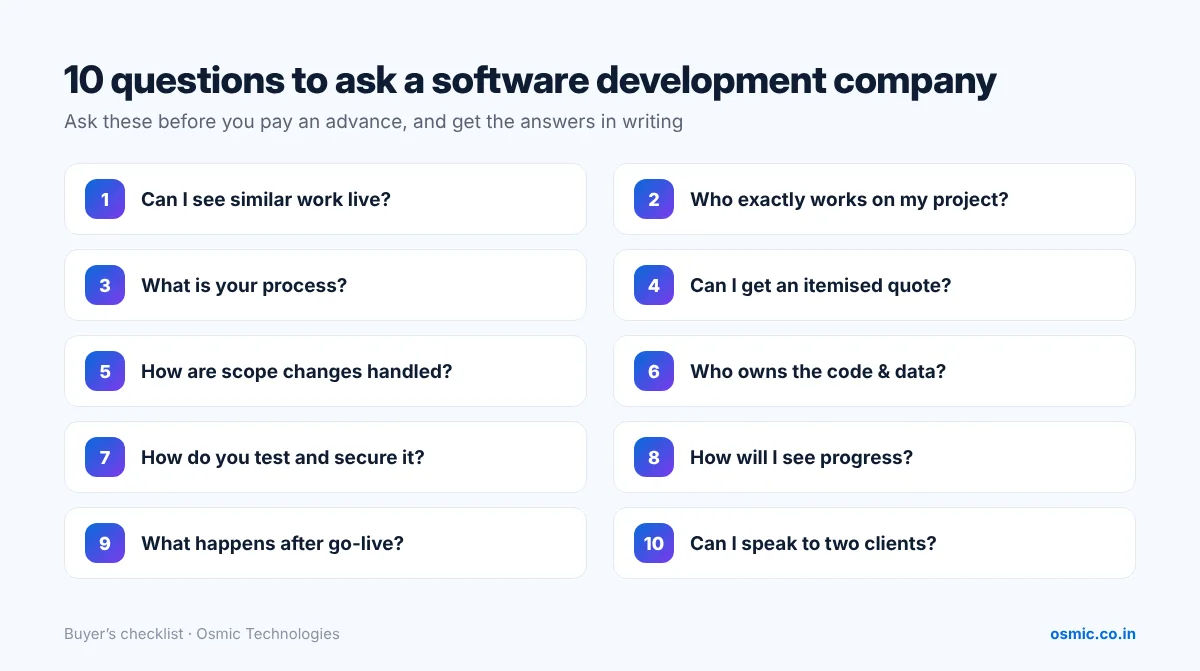
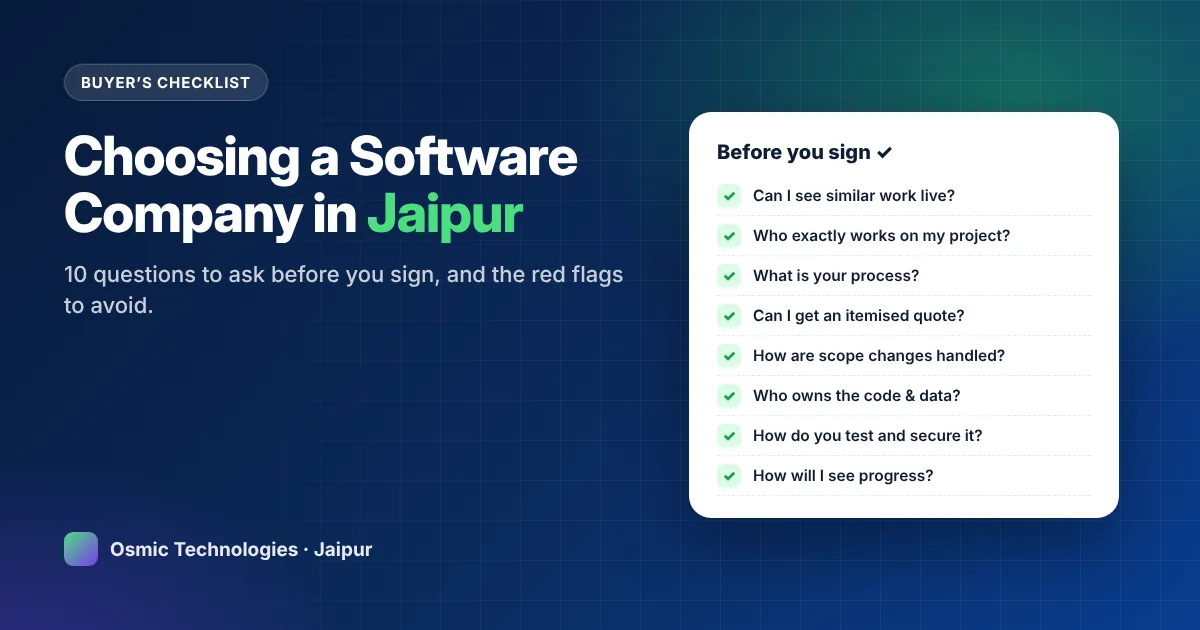
1. “Have you built something similar, and can I see it working?”
Not a PDF portfolio. A live system, an app on the Play Store, or a recorded demo. Experience in your type of software (ERP, school management, e-commerce, booking, CRM) means fewer surprises, because they’ve already solved the problems you haven’t thought of yet.
2. “Who exactly will work on my project?”
Ask for names and roles: project manager, developers, designer, tester. Find out whether they’re full-time employees or subcontracted freelancers. You should have one accountable point of contact who answers your calls.
3. “What does your development process look like?”
A reliable company will describe something like: requirement workshop → written scope → design approval → development in milestones → testing → user training → go-live → support. If the answer is “we’ll start coding and show you at the end”, walk away.
4. “Can you give me an itemised quote?”
A single lump sum hides assumptions. An itemised quote shows modules, features and effort, so you can compare vendors fairly and drop or postpone items to fit your budget. It also becomes the reference point if there’s a disagreement later.
5. “How do you handle changes in scope?”
Requirements always change, and that’s normal. What matters is how changes are estimated, approved and billed. Get the change process in writing: a written change request, an estimate, your approval, then work.
6. “Who owns the source code and data?”
This is the question people forget and later regret. Your contract should say the source code, database and intellectual property transfer to you on final payment. Also confirm you’ll have admin access to the hosting server, domain, code repository and any third-party accounts such as payment gateways or SMS providers.
7. “How do you test, and how do you secure my data?”
Ask whether they have a dedicated tester and test on real devices and browsers. For security, ask about role-based access, password hashing, HTTPS, backups and how customer data is protected. If they can’t explain this in plain language, that tells you something.
8. “How will I see progress?”
Weekly demos, a shared staging link and a simple progress tracker beat a monthly “almost done” email. Regular visibility catches misunderstandings while they’re still cheap to fix.
9. “What happens after go-live?”
Clarify the free warranty period (often 1–3 months for bug fixes), then the cost of an annual maintenance contract (AMC). Understand response times for critical issues, and whether they handle hosting, backups and updates.
10. “Can I speak to two of your clients?”
A confident company will connect you. Ask those clients three things: did the project finish on time, how were problems handled, and would they hire them again?
Red flags to watch for
- A price given before they understand your requirements.
- Pressure to pay a large advance immediately.
- Vague answers on code ownership or hosting access.
- No written scope, only verbal promises.
- Every past project is “confidential” and nothing can be shown.
- Very low quotes. They usually reappear later as change requests.
Fixed price or monthly retainer?
Fixed price suits well-defined projects such as a school management system with standard modules. Time-and-material or monthly retainers suit products that will evolve, like a startup platform. A practical middle path: a fixed-price first version, then a monthly retainer for enhancements.
Why a local partner can make sense
Business software depends on understanding how your team actually works. Being able to sit in your office for a requirement workshop, train your staff in person or visit when something critical goes wrong is a real advantage. A Jaipur-based team also understands local business practices, GST and billing needs, and regional customer behaviour.
A simple scoring sheet
Score each shortlisted company from 1 to 5 on: relevant experience, process clarity, quote transparency, ownership terms, communication, support terms and client references. The highest score, not the lowest price, is usually the safest choice.
What a good proposal should contain
Once you’ve shortlisted two or three companies, ask each for a written proposal. A serious one includes:
- Understanding of your problem in their own words. If they can’t explain your business back to you, they didn’t listen.
- Scope: modules and features, with what is explicitly out of scope.
- Technology choices and why they suit your project.
- Team and roles assigned to your project.
- Timeline with milestones and what you’ll see at each one.
- Itemised cost and payment terms linked to milestones.
- Assumptions: who provides content, data, hosting and third-party accounts.
- Support and maintenance terms after go-live.
Clauses to check in the contract
- Intellectual property and source code transfer on final payment.
- Confidentiality and non-disclosure, including your customer data.
- Acceptance criteria: how you’ll test and sign off each milestone.
- Change request process and rates.
- Warranty period for bug fixes at no cost.
- Exit terms: handover of code, documentation and credentials if you part ways.
None of this is about distrust. Clear terms protect both sides and keep the project focused on delivery.
Consider a small paid pilot
If the project is large, start with a short paid phase: a requirement workshop and specification, a clickable prototype, or one module built end to end. In two to four weeks you’ll learn how the team communicates, how they handle feedback and the quality of their work, for a fraction of the total budget. If it goes well, you continue with confidence. If not, you’ve limited the damage and still own a useful specification.
Next step
If you’re evaluating partners for custom software, ERP, CRM or a web application, we’re happy to answer every one of these questions on a call, in writing. Explore our custom software development services or hire dedicated developers for an ongoing project.
Talk to our software team in Jaipur
Get honest answers to all 10 questions, plus an itemised proposal for your project.
Book a free consultation →