Software sales conversations with colleges often go the same way. The institute asks for help with fee collection, attendance and exams. A vendor arrives with a 40-module ERP covering procurement, fleet management and fixed-asset depreciation. A year later, the college uses five modules, staff still keep Excel sheets “just in case”, and the annual licence keeps renewing.
The opposite happens too: a growing university group picks a simple system and outgrows it within two admission cycles. Choosing correctly starts with understanding the difference.
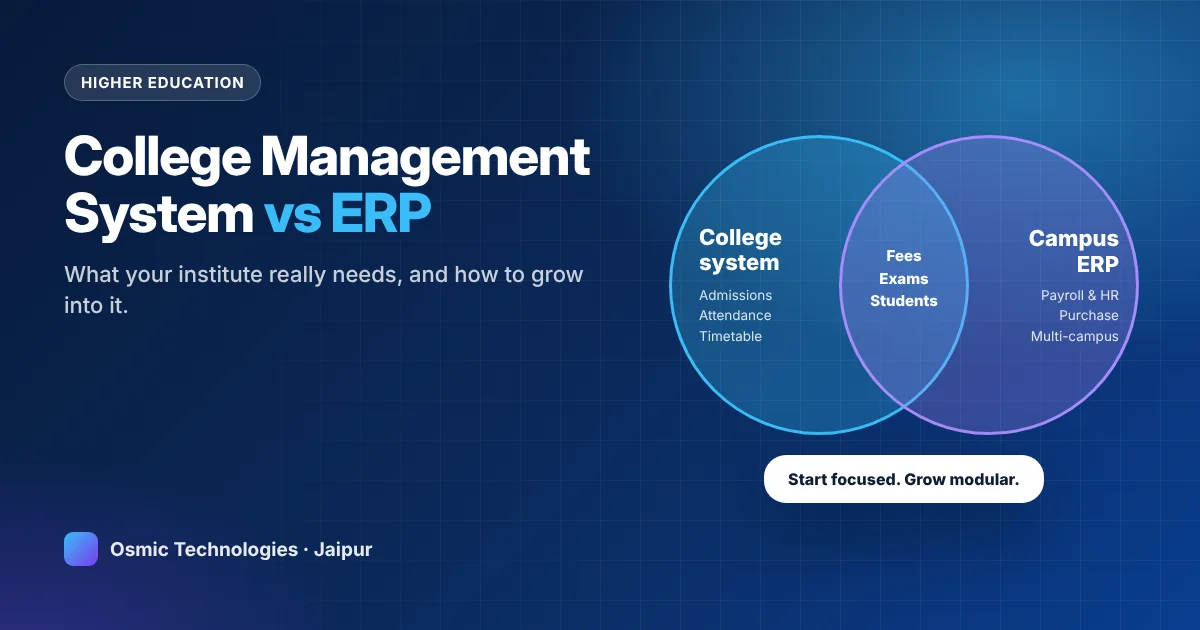
What a college management system does
A college management system (CMS) focuses on the student lifecycle and academic administration:
- Online enquiry, admission and document verification
- Student information, course and section allocation
- Fee structures, scholarships, instalments and online payment
- Attendance (including subject-wise and biometric integration)
- Timetables, lesson plans and faculty workload
- Internal assessments, exams, results and mark sheets
- Student and parent portal or app, notices and circulars
- Library, hostel and transport as add-ons
What a full campus ERP adds
A campus ERP covers everything above plus the institution’s back office:
- Finance and accounting, budgets and audit trails
- HR, recruitment, payroll and staff appraisal
- Purchase, inventory and asset management
- Multi-campus and multi-institute control under one trust
- Research, placement and alumni management
- Advanced analytics and dashboards for management
Five questions that decide which one you need
1. How many campuses and students do you manage?
A single college with up to a few thousand students rarely needs ERP-level complexity. A trust running several colleges, schools and hostels usually does, because consolidated finance and reporting become essential.
2. Where does the pain actually sit?
If your biggest headaches are fee follow-ups, exam results and attendance compliance, a CMS solves them directly. If you’re struggling with purchase approvals, payroll across institutions and fund-level accounting, you need ERP capabilities.
3. Who will use the software every day?
Every extra module needs trained users and someone to own it. Be honest about your team’s capacity. Software that nobody updates produces wrong reports, which are worse than no reports.
4. What are your accreditation and reporting needs?
NAAC, NIRF, AISHE and university returns all require structured data on students, faculty, results, research and infrastructure. Whichever system you choose should store this data in the right structure from day one, so reports come out of the system instead of from a week of manual compilation.
5. What is your budget over five years, not one?
Compare total cost of ownership: licence or development, implementation, data migration, training, hosting, support and future modules.
Cost comparison (India, 2026)
- Subscription college software: typically priced per student per year, quick to start, limited customisation.
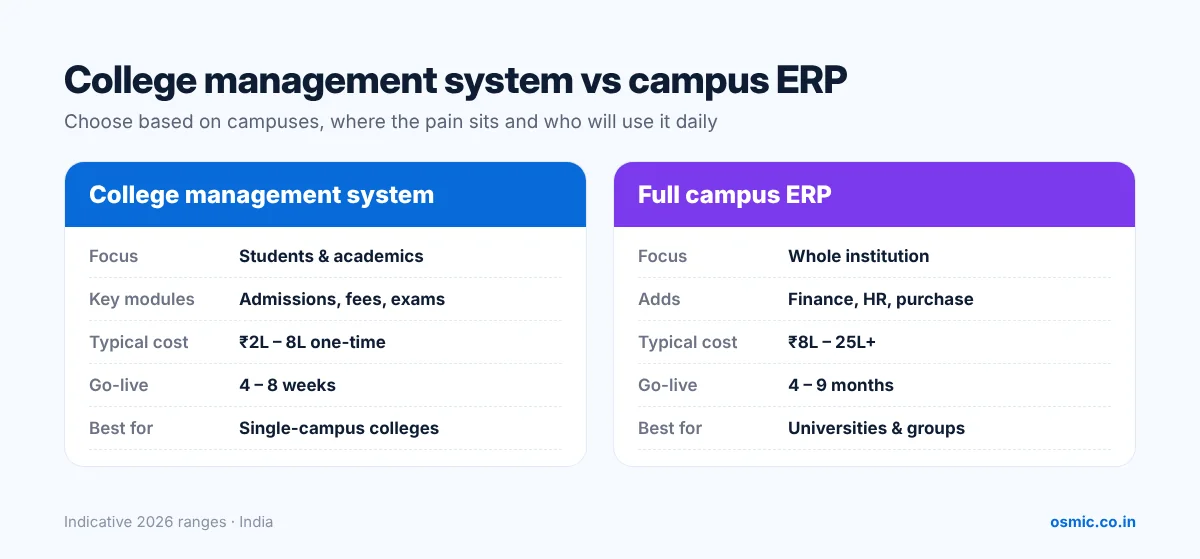
- Custom college management system: about ₹2 lakh – ₹8 lakh one-time, depending on modules, plus maintenance and hosting.
- Full campus ERP: from around ₹8 lakh to well above ₹25 lakh, depending on modules, campuses and integrations.
Implementation time follows the same pattern: a focused CMS can go live in 4–8 weeks, while a full ERP rollout often takes 4–9 months.
The smart middle path: modular from day one
You don’t have to choose between “small now” and “big forever”. A modular system built on a single database lets you:
- Start with admissions, fees, attendance, exams and the student app, where the pain is.
- Add accounting integration (or Tally sync) once fee data is clean.
- Add HR and payroll, then inventory and analytics, as the institution grows.
Each phase delivers value on its own, staff learn gradually, and you never pay for modules nobody uses.
Implementation tips that save months
- Clean your data before migration, especially student records, fee balances and roll numbers.
- Appoint module owners: one person each for admissions, fees, exams and accounts.
- Train by role, not with one big session for everyone.
- Run one full exam cycle in parallel before switching off the old process.
- Agree reporting formats early so university and accreditation reports come straight out of the system.
Reports your management will ask for
Whichever system you pick, check that it produces these without manual work:
- Daily fee collection and outstanding dues by course and semester
- Subject-wise and student-wise attendance with shortage lists
- Result analysis by subject, faculty and batch
- Admission funnel: enquiries, applications, confirmed admissions
- Faculty workload and timetable utilisation
- Data formats needed for university returns, AISHE and NAAC criteria
Integrations to plan for
- Payment gateway for online fees with automatic reconciliation
- Accounting: Tally sync or built-in accounting
- Biometric or RFID attendance devices
- SMS, WhatsApp and email for alerts and notices
- Learning management system or video classes, if you run blended courses
- University portals where data must be uploaded in set formats
Integrations are often what separates a system people use from one they work around, so list yours before asking for quotes.
Questions to ask vendors
- Can you show this working at a college similar to ours in size and courses?
- How do you handle our university’s grading and exam patterns?
- Which modules are included in the quoted price, and which cost extra later?
- Where is data hosted, and can we export all of it at any time?
- What training and support do you provide during admissions and exam season?
- If we start with academic modules, how do finance and HR plug in later?
An example
Imagine a private engineering and management college in Rajasthan with around 2,500 students on one campus. Its real pain is fee follow-up, attendance shortage tracking and exam results. A focused college management system with fees, attendance, exams, a student app and Tally integration solves these in a single semester. If the trust later opens a second college and a nursing school, the same platform can extend to multi-campus finance and HR, without paying for a full ERP on day one.
Our recommendation
For most single-campus colleges, a well-built college management system with clean fee, exam and accounting integration delivers most of the value at a fraction of ERP cost and complexity. Universities and multi-institute trusts should plan an ERP, but roll it out in phases, starting with academics and fees.
Want to see what fits your institute? We’ll walk you through a live college management system demo and map a phase-wise plan. For schools, see our school management software.
Find the right system for your institute
Get a live demo and a phase-wise plan, from a focused college system to a full campus ERP.
Book a free demo →